Cornell University — RADIX Used in Ice Plant Photoperiod Research
At Cornell University in Ithaca, New York, researchers used a SANANBIO RADIX module to study how light affects the growth of common ice plant (Mesembryanthemum crystallinum L.), a leafy vegetable valued for its nutritional profile. The work was published in an open-access journal in 2022.
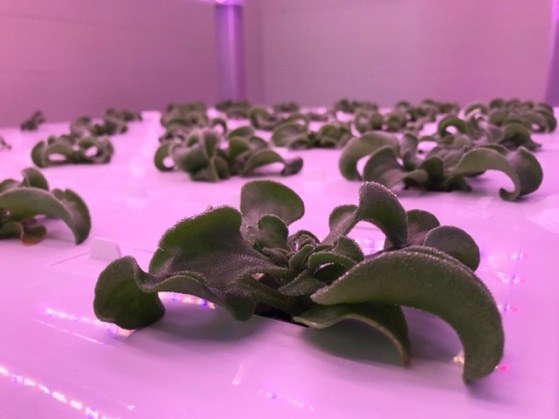
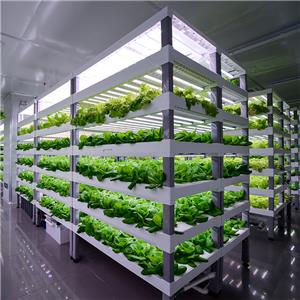
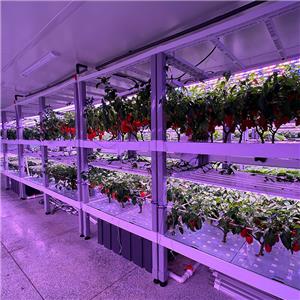
The experiment ran on a five-layer RADIX system with 30 cm between each layer and the light above it. Each layer was set to a different photoperiod — 8, 12, 16, 20 or 24 hours of light per day — using SANANBIO VegMax spectrum LED fixtures. At a 20-hour photoperiod the system delivered a daily light integral of 14.4 mol/m²/day. The RADIX module's hybrid NFT-DWC irrigation, with gravity-driven water circulation, supplied the plants throughout the trial.
The study is a research application, not a commercial farm, and it is included here for what it demonstrates about the equipment: a university research team chose RADIX because each layer could be controlled independently, letting them run five different light treatments in a single compact unit. That same layer-by-layer control is what lets commercial growers tune light recipes for different crops and growth stages.
Cornell is one of several universities using SANANBIO systems for controlled-environment research. The paper documents RADIX as research equipment; the plant responses measured in the experiment are research findings, not guaranteed commercial performance of the system.
---
Frequently Asked Questions
What crop did Cornell researchers study on the RADIX module?
Common ice plant (Mesembryanthemum crystallinum L.), a leafy vegetable valued for its nutritional profile. The work was published in an open-access journal in 2022.
How was the five-layer RADIX system set up for the experiment?
Each layer was set to a different photoperiod — 8, 12, 16, 20 or 24 hours of light per day — with 30 cm between each layer and the light above it, using SANANBIO VegMax spectrum LED fixtures. At a 20-hour photoperiod the system delivered a daily light integral of 14.4 mol/m²/day, and the RADIX module's hybrid NFT-DWC irrigation, with gravity-driven water circulation, supplied the plants throughout the trial.
Why did the research team choose RADIX?
Because each layer could be controlled independently, letting them run five different light treatments in a single compact unit. That same layer-by-layer control is what lets commercial growers tune light recipes for different crops and growth stages.
Is this a commercial farm?
No — the study is a research application, not a commercial farm. The paper documents RADIX as research equipment, and the plant responses measured in the experiment are research findings, not guaranteed commercial performance of the system.
Can each RADIX layer run a different light schedule?
Yes. At Cornell, each of the five RADIX layers ran a different photoperiod — 8, 12, 16, 20 or 24 hours of light per day — because each layer can be controlled independently. That layer-by-layer control also lets commercial growers tune light recipes for different crops and growth stages.