NFT vs DWC: Two Hydroponic Methods Compared
NFT and DWC are two widely used hydroponic methods. This guide explains how each works, their strengths and limits, which crops they suit, and how to choose — including how SANANBIO RADIX relates to both.
NFT and DWC are two widely used hydroponic methods. Both grow plants without soil, feeding them with a recirculating nutrient solution. They differ in how the roots meet that solution — and that difference shapes how they are built, maintained and used. This guide explains how each method works, their strengths and limits, which crops they suit, and how to choose between them.
What is NFT?
NFT stands for Nutrient Film Technique. A thin film of nutrient solution flows through a shallow channel, often called a gully or channel. The plant roots sit in that film — partly in the solution and partly exposed to air — while the solution recirculates from a tank through a pump back to the channels.
Because the roots are partly exposed to air, NFT gives them good access to oxygen. The system uses little water, since only a thin film flows through the channels, and the roots are easy to inspect by lifting a channel lid.
NFT works well for leafy greens and herbs, which have compact root systems that fit the shallow channels. It is widely used in commercial leafy-green production.
Strengths of NFT
- Good oxygen supply to the roots from air exposure in the channel.
- Efficient water and nutrient use — only a thin film circulates.
- Easy root inspection and modular channels that scale by adding more runs.
- Suited to leafy greens, herbs and other compact crops.
Limits of NFT
- Depends on the pump: if the pump stops, the thin film drains and roots dry out quickly.
- Channels must be level so the film flows evenly along the whole run.
- Channels can clog with roots or debris if they are not cleaned.
- Less suited to large, heavy fruiting plants whose root mass outgrows the shallow channel.
What is DWC?
DWC stands for Deep Water Culture. The plant roots hang in a deep reservoir of nutrient solution that is kept oxygenated by an air pump and air stones. Plants are held in net pots or on floating rafts, with the roots suspended in the solution.
Because the roots stay in the solution, a brief pause in the pump is less damaging than in NFT — the roots do not dry out. The large solution volume also buffers changes in nutrient strength and pH.
DWC works well for leafy greens and herbs, and it can also support larger plants, since the deep reservoir gives roots room to grow.
Strengths of DWC
- Roots stay in solution, so a short pump interruption is less damaging.
- Simple and stable to run, with a large solution volume that buffers nutrient and pH changes.
- Strong growth for leafy greens and herbs, and room for larger root systems.
- Straightforward to build and to expand by adding more reservoirs.
Limits of DWC
- Needs continuous aeration: without dissolved oxygen from the air pump, roots suffocate.
- Solution temperature matters, because warm water holds less dissolved oxygen.
- A shared reservoir can spread root disease from one plant to others if it appears.
- Uses more water volume than NFT, and the reservoir needs regular cleaning.
NFT vs DWC at a glance
- How roots get nutrients: NFT uses a thin flowing film in a channel; DWC suspends roots in a deep oxygenated reservoir.
- Oxygen: NFT gets oxygen from air exposure in the channel; DWC gets it from an air pump and air stones.
- Water volume: NFT uses a thin film and little water; DWC holds a deep reservoir.
- If the pump stops: NFT roots dry out quickly; DWC roots stay wet but still need oxygen.
- Maintenance: NFT needs level channels and clog prevention; DWC needs aeration, temperature control and reservoir cleaning.
- Best crops: both suit leafy greens and herbs; DWC gives more room for larger plants, while NFT suits compact crops in channels.
How to choose
- Crop: compact leafy greens and herbs suit either method; larger or heavier plants favour the room of DWC.
- Scale: NFT channels scale by adding runs; DWC scales by adding reservoirs.
- Power reliability: if the power supply is unreliable, DWC is more forgiving of a brief pump stop than NFT.
- Experience: both need regular checks, but NFT needs attention to channel level and clogging, while DWC needs attention to aeration and solution temperature.
- Water: NFT uses less water volume; DWC needs a larger reservoir and more water on hand.
Where SANANBIO RADIX fits
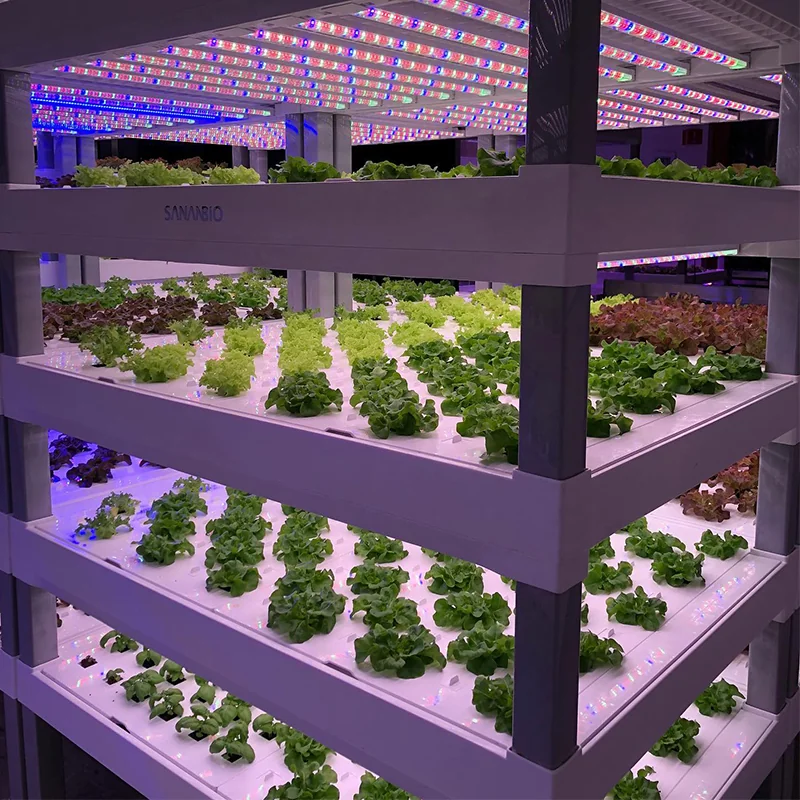
SANANBIO RADIX is a modular multi-layer hydroponic growing system that uses NFT-DWC hybrid irrigation — it combines elements of both methods rather than being a pure NFT or a pure DWC system. Growers comparing system options can look at the RADIX hydroponic module for leafy greens, or the ARK container farm for modular, relocatable production.